DIY Home First Aid Kit – Free Checklist
Must Have – First Aid Kit Checklist
DIY Home First Aid Kit – Free Checklist. Here’s another “must have” item everyone should own – a FIRST AID KIT. A well-stocked first aid kit is a handy thing to have. And to be prepared for all emergencies you should have one in your home and in your car. Rather than spend an arm and a leg on a pre-made kit from your box store, you can also just make your own (DIY). And don’t worry as a DIY FIRST AID KIT won’t cost you a fortune to make as most of these items can be purchased from your local Dollar Store and/or be bought cheaply enough at your local drug store or box store.
Now let’s put this First Aid Kit together.
First thing is picking a container. As you can make one any shape or size, it doesn’t have to be huge or elaborate either. I’m a big time keeper of shoe boxes, all sizes. So naturally my first aid kit is a large shoe box, which is tied closed with shoelaces so it can be easily carried around, and is kept in our bathroom cabinet. You can go big and opt for a backpack or a duffel bag, use a medium size plastic tote, or go as small as a nice size lunchbox. It should be easy to transport to an emergency, so something with a handle is ideal. And whatever container you decide to use, definitely mark it FIRST AID !!
The contents should include the following. A more detailed list is described below these items. 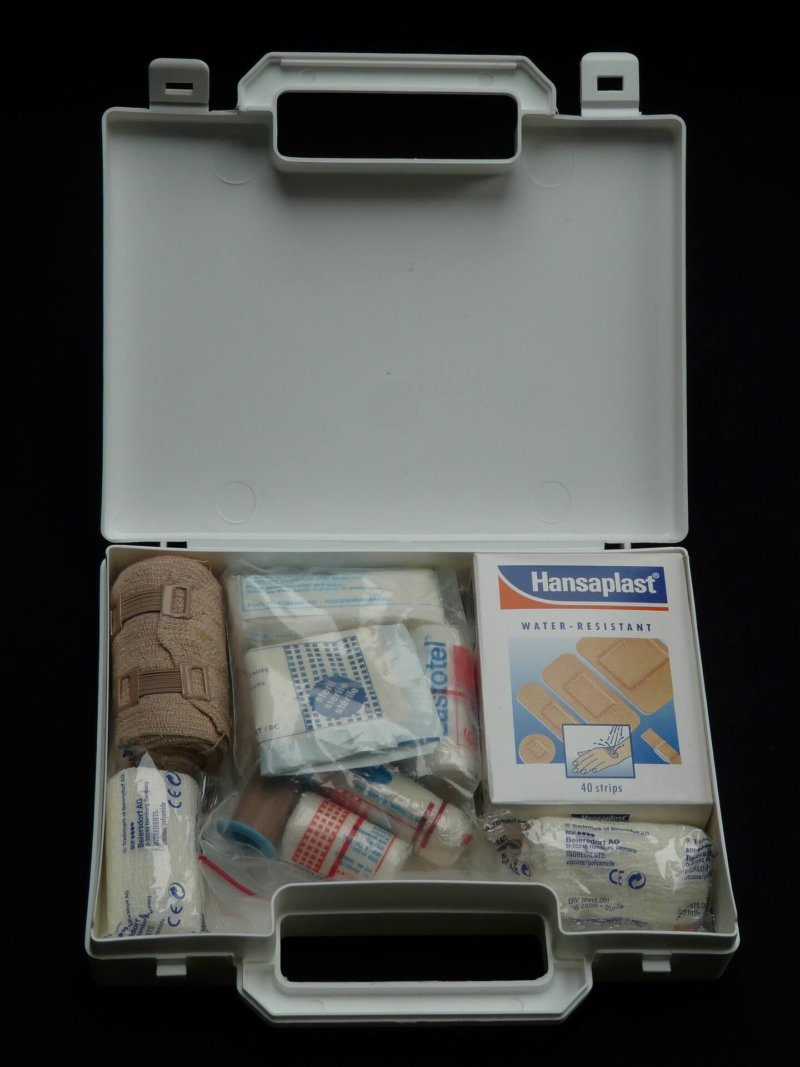
- Wound Cleaning Agent – small bottle of hydrogen peroxide or Hibiclens. Alcohol wipes are good to have but they will sting
- Band Aids – all sizes
- Butterfly closures – for deep wounds. Use these to keep the edges together, use some gauze and pressure to control bleeding until you find medical care.
- Antibiotic ointment – individual packets or a tube of neosporin to prevent infection
- Nitrile exam gloves – used to prevent coming in contact with someone else’s blood or other bodily fluids that may be harmful to you.
- Gauze – 4×4 pads and rolled gauze for a bleeding wound
- Triangular bandages – these can be used for a variety of situations; from a sling to temporarily treating a fracture, to splinting a foot or ankle, or even used to tie splints around a broken leg.
- Burn Treatment – treatment includes cooling it off somehow and wrapping the burned area with sterile gauze/dressing. Get a simple burn gel packet to place on a burn before wrapping it.
- Over The Counter Medication – Ibuprofen (Motrin or Advil) and acetaminophen (Tylenol, Paracelamol) are great for pain relief and reducing fever. Ibuprofen helps reduce inflammation. Diphenhydramine (Benadryl) for cases of mild allergic reactions. Aspirin (Bayer) just in case you witness a possible heart attack. An Epi-Pen if you need one.
- Small basic medical tools for first aid – tweezers, small scissors, etc.
*****************************************
HERE IS A PERFECT EXAMPLE OF WHAT SHOULD BE INSIDE A GOOD FIRST AID KIT:
ARRAY OF BANDAGES: ALL SIZES PLACED IN A ZIP LOCK BAG
- 25 adhesive bandages of various sizes
- Five 3” x 3” and five 4” x 4” gauze pads
- A roll of cloth adhesive tape
- Two 5” x 9” sterile dressings
- One 3” wide and one 4” wide roller bandage (ace bandage)
- Two triangular bandages
CLICK HERE FOR YOUR PRINTABLE PDF CHECKLIST
BASIC MEDICAL TOOLS: FOR PULLING SPLINTERS, CUTTING BANDAGES, AND OTHER FIRST AID (KEEP THEM TOGETHER IN A ZIP LOCK BAG)
- Small, sharp scissors
- Tweezers
- Two pairs of non-latex gloves
- Non-mercury oral thermometer
- Cotton balls and swabs
- CPR breathing barrier mask
- Instant cold compress
- First aid instruction booklet
- Cleansing wipes (for external cleaning only)
- Zip-close plastic bags (to dispose of medical waste)
MEDICATION & OTHER OTC ITEMS (BUY TRAVEL SIZES)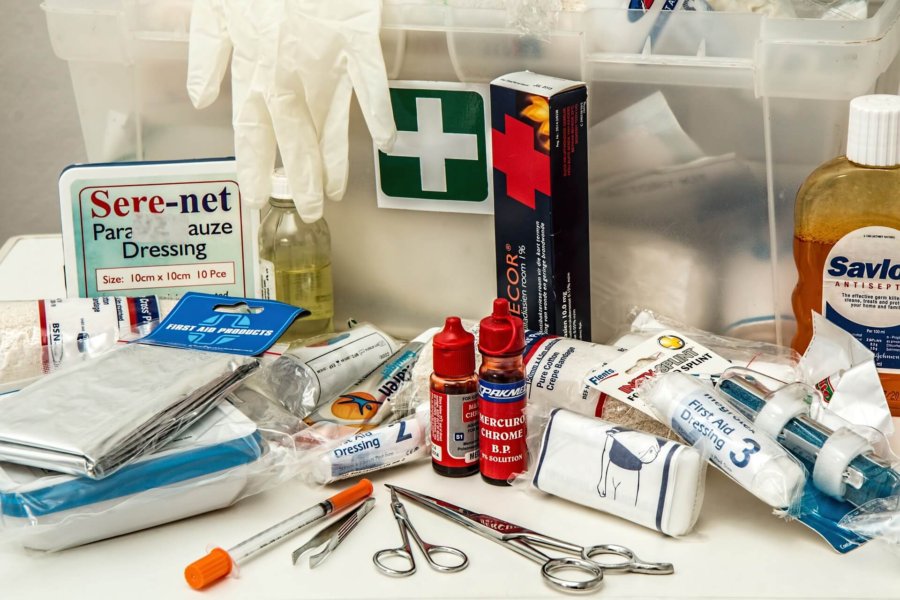
- Small Hand Sanitizer
- Aloe vera gel
- Calamine lotion
- Anti-diarrhea medication
- Laxatives
- Antacids
- Antihistamines
- Pain relievers (aspirin, ibuprofen, and acetaminophen)
- Hydro-cortisone cream
- Cough/cold medicine
ADDITIONAL TOOLS: NON ESSENTIAL BUT USEFUL (only if you have room in your kit)
- Eye protection
- Prepackaged space (warming) blanket
- Aluminum finger splint
- Duct tape
- Petroleum jelly
- Sewing needle
- Safety pins
- Turkey baster (for flushing out wounds)
FAMILY MEDICATION IF NEEDED:
- Small doses of prescription medication for each family member if the kit is in your car
- Keep close track of prescription medication expiration dates.
- If anyone in your family has severe allergies and a prescription for an epi-pen, keep one in the home kit with instructions, so a visitor could provide assistance in an emergency.
- Even for home kits, keeping a small stock of personalized medical supplies — a bee sting kit, for example — can prove useful if your medicine cabinet supply happens to be depleted.
*****************************************
Here is your printable list – now go put that first aid kit together
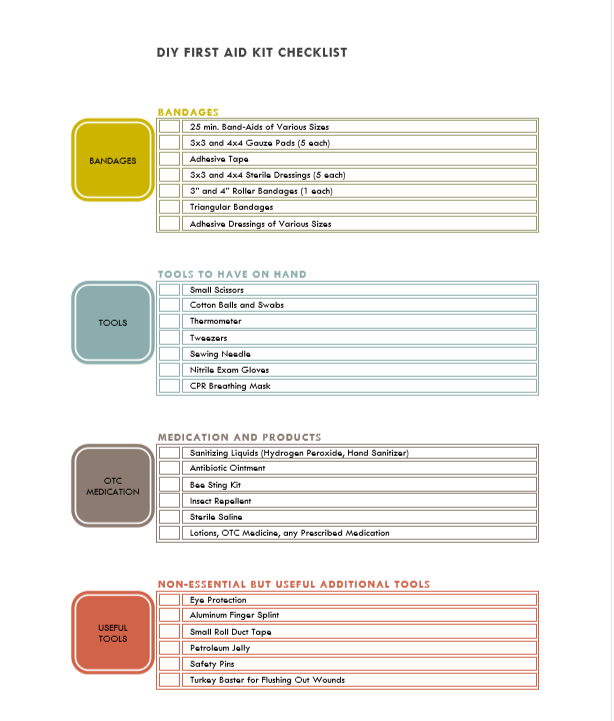
CLICK HERE FOR YOUR PRINTABLE PDF CHECKLIST
The Red Cross recommends that all first aid kits should include the following:
2 absorbent compress dressings (5 x 9 inches)
25 adhesive bandages (assorted sizes)
1 adhesive cloth tape (10 yards x 1 inch)
5 antibiotic ointment packets (approximately 1 gram)
5 antiseptic wipe packets
2 packets of aspirin (81 mg each)
1 emergency blanket
1 breathing barrier
1 instant cold compress
2 pair of nonlatex gloves (size: large)
2 hydrocortisone ointment packets (approximately 1 gram each)
1 3 in. gauze roll (roller) bandage
1 roller bandage (4 inches wide)
5 3 in. x 3 in. sterile gauze pads
5 sterile gauze pads (4 x 4 inches)
Oral thermometer (non-mercury/nonglass)
2 triangular bandages
Tweezers
Emergency First Aid guide
This is awesome! I don’t have a first aid kit at home which is wrong!!!! I need to have one for sure.
Such a very helpful blog! We really need a first aid kit in our home, even when we get outside. Thanks for the ideas you’ve shared!
This is precious. We usually underestimate the need for an emergency kit but we shouldn’t. It can be lifesaving.
Very useful post. In fact, I was looking for such compact information on what should be the first aid kit at home. I keep medicines ready , antiseptic lotions and creams too. But not the different types of bandages, will do so.
This is super handy! thank you for the home first aid kit. Thank you for sharing
I was checking that if I have all this in my home first aid kit. All checked!
Wow i was looking for something like this to make myself.It is really important to have first aid kit at home.Thanks for DIY ideas.
Thank you After last years covid hit, this was one of the first things I put together. Even have one in my truck.